
Akai Chew
Web: www.akaichew.com
IG: @_akai_theartist
Biography
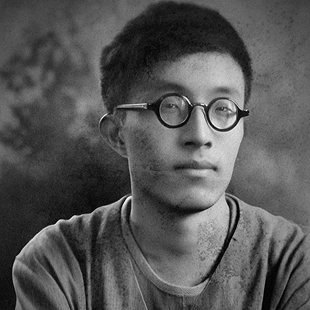
Akai Chew (b. 1987) has a background in architecture, heritage conservation, urban planning, and photography. He studied architecture at the University of Tasmania, where an ever-present hidden history of the First Nations is strongly embedded in the curriculum. Returning to Singapore, he applied this lens to his surroundings, exploring the hidden histories of places and spaces in his practice. His work is grounded in a site-specific, observation- and research-based methodology. With architecture as a starting point, Chew works across photography, mapping, and installation art.
Connecting these diverse projects are common threads of urban memory, stratum of histories, and contested geographies.
He has exhibited in Perth, New Delhi, Bandung, Hobart and Launceston. Highlights of his career include Memory Space in Pantopicon II x Dark MOFO 2018, the National Gallery of Singapore commission Fragment Of A Shorline for Light to Night 2022, and the commission This Particular Place for Archifest 2023.
Artworks
A Liminal Desire to Exist
2026
Video
Installation
Sand, GAN-generated video, found objects
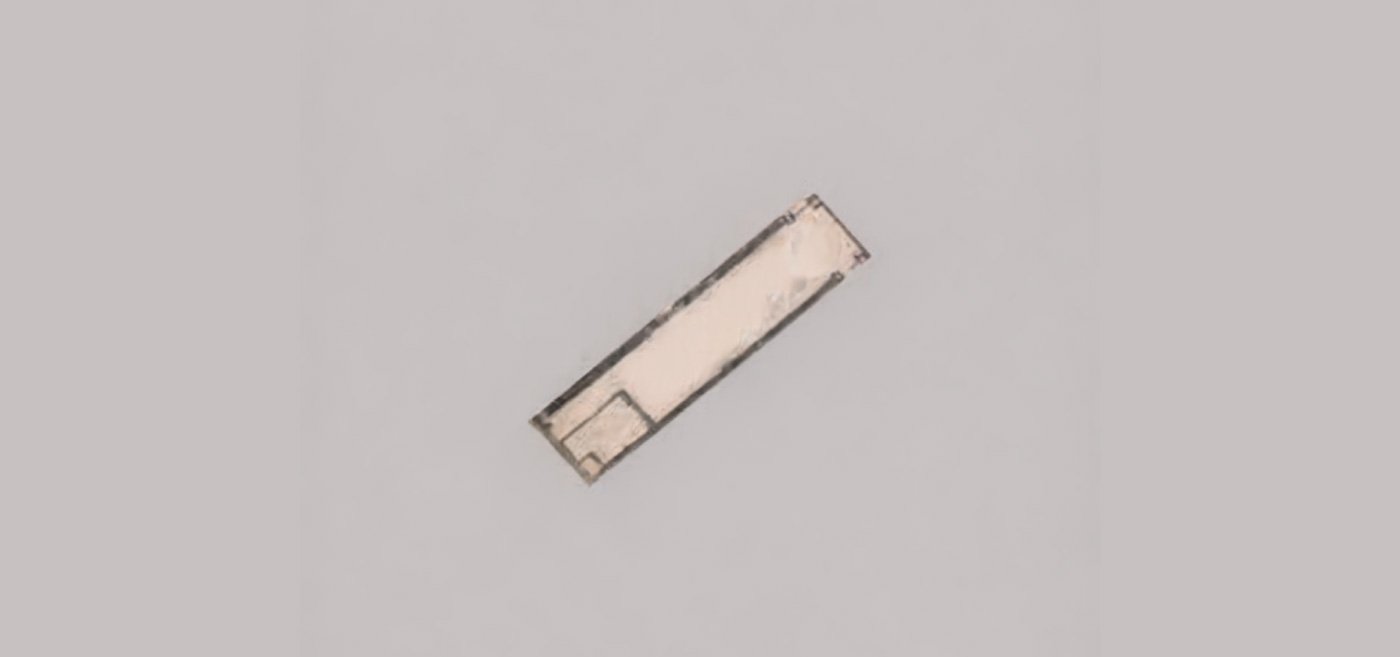
More than 1,100 archival floor plans are reworked as speculative and generative architectures set within a corner installation in “The Strange Archive”. Removed from their original function as instruments of order, these maps are made strange—reframed and estranged into generative plans. In a city shaped by continual redevelopment, the architectures they describe exist in a prolonged state of limbo, registering the instability of urban form, where spaces are repeatedly erased, revised, and reimagined, and where what once stood lingers only as traces.
Within this latent space, architecture persists as a process rather than a fixed form, occupying the fragile intervals between memory and erasure, knowledge and speculation. The generative AI videos wriggle and vibrate as they are disquietingly set within shelving and presented as fixed knowledge, even as sand flows out from them, unsettling their authority and underscoring the provisional nature of the archive itself.
North Bridge Garden
2026
Print on aluminium
16 cut-out pieces
Variable dimensions
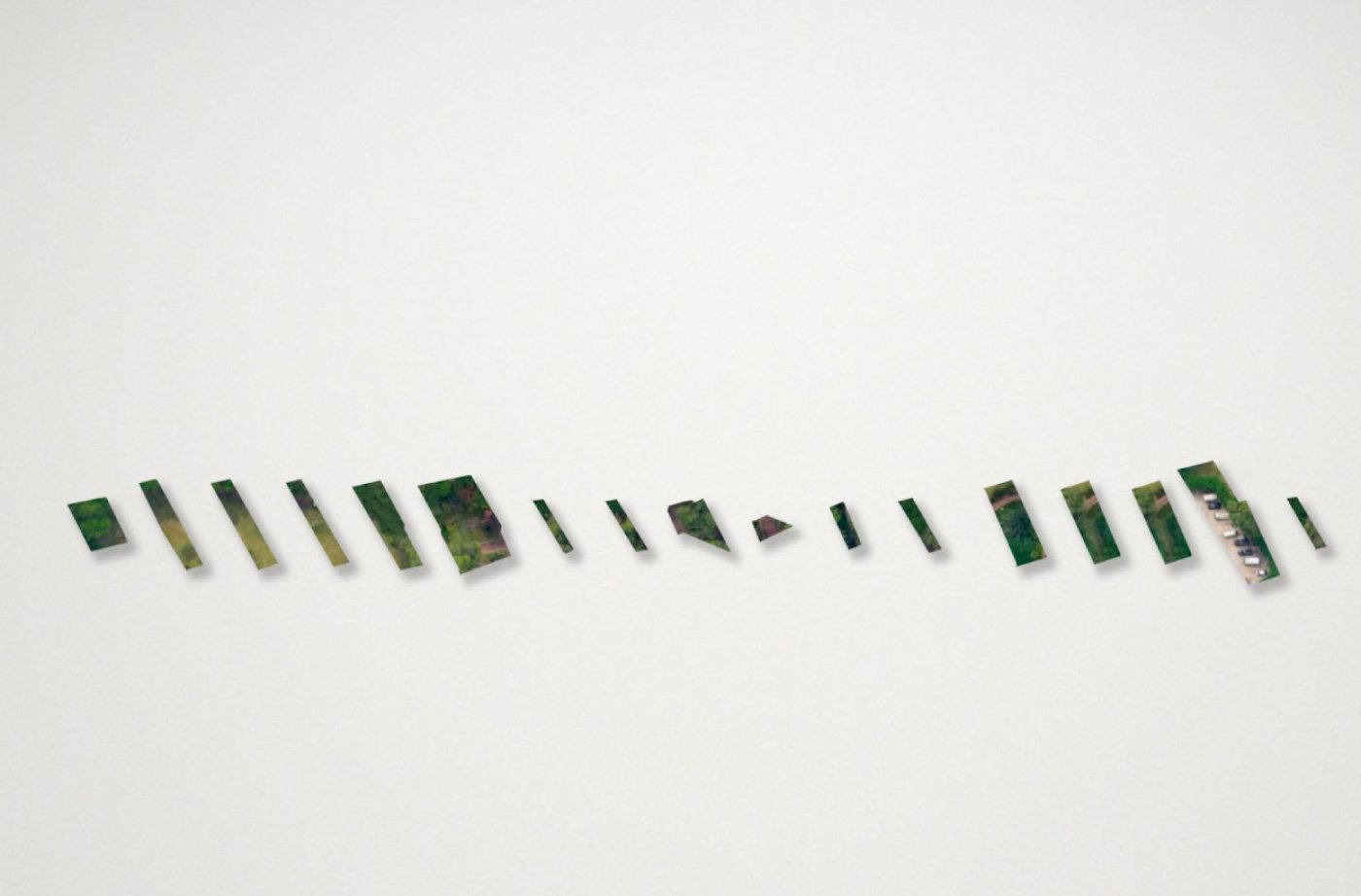
Following tabula rasa redevelopment, the cadastral lots of the previous landscape are left behind. These parcels persist in maps, survey records, and land ownership titles, yet no longer align with the city that has been built above them. They remain legally present but spatially invisible.
A cadastral lot is a surveyed unit of land used for administrative and legal purposes. It defines ownership and boundaries rather than lived experience or architectural form, functioning as a conceptual archive—abstract, regulatory, and largely hidden from public view. In this work, these lots are rendered as fragmented and blurred unclear forms, acknowledging their instability and the difficulty of locating them within the contemporary city.
Printed on aluminium, the green abstract patterns translate cadastral boundaries into shifting, non-representational fields. What was once a shophouse, a warehouse, or a mosque survives only as an outline and designation, reduced to a legal trace rather than a social space. The work reflects this condition by allowing the image to remain unsettled—hovering between documentation and disappearance.
A Survey of Absent Places: Precinct N1 & N3
2026
Archival printing on cotton rag
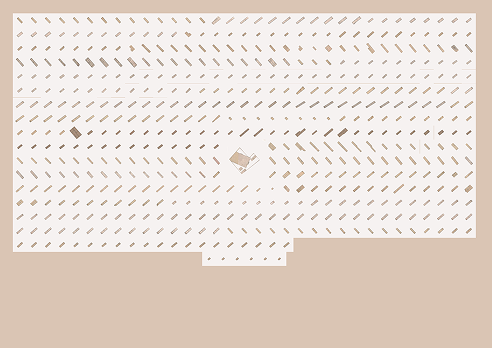
This diptych reimagines Singapore’s final chapter of tabula rasa urban renewal by returning to the architectures and micro-histories that once occupied two major redevelopment zones. From the 1960s to the 1990s, large parts of the city were cleared to make way for modern housing and infrastructure—beginning with Precinct N1 in 1965 and culminating in the clearing of areas within Precinct N3 in 1995. Entire neighbourhoods and communities were displaced or reshaped as the nation pursued an optimistic vision of progress built on newness.
In this work, Akai Chew isolates every architectural structure from Precincts N1 and N3 and arranges them alphabetically, producing a matrix that reimagines the city’s fragments as a typological field with new associations. Patterns, repetitions, and anomalies emerge, allowing viewers to encounter the built environment as a constellation of dislocated pieces rather than a continuous landscape. Each fragment gains presence while simultaneously forming part of a larger visual system, echoing the typological strategies of Bernd and Hilla Becher while redirecting them toward Singapore’s histories of renewal and erasure.
Chew foregrounds the paradox of the survey as a tool that records and erases at the same time. Surveys document, measure, and preserve, yet they also prepare the conditions for demolition. By assembling these remnants anew, the work reimagines what renewal has rendered invisible and invites reflection on how absence continues to shape our understanding of the present city.
Reclamation and Redemption
2026
Installation
Sand,
GAN-generated video, found objects
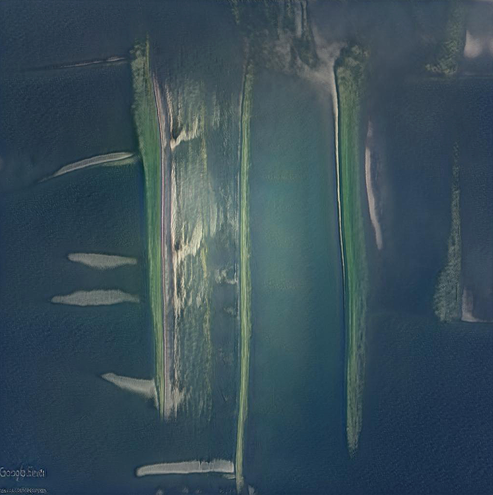
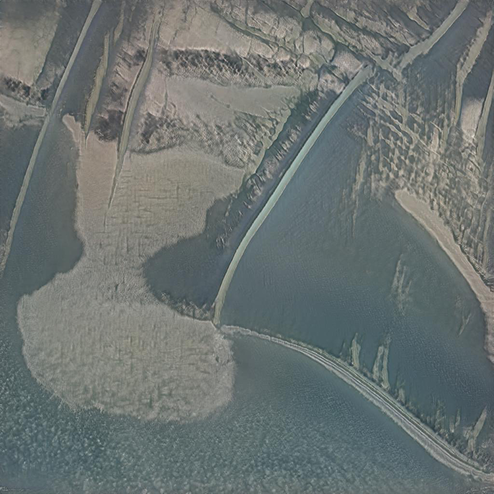
For this work, 500 satellite images of beaches and land reclamation sites from former British colonies were fed into a generative adversarial network (GAN). The resulting video and stills form a speculative visual field, imagining how coastlines are reshaped through large-scale reclamation in the name of urban and economic development.
These machine-generated images reflect the logics that often drive reclamation: the mechanical need for more land, the demands of economic growth, and the rationality of planning policies and zoning regulations, where aesthetic or ecological considerations are frequently secondary. Reclamation projects overwrite existing landforms, producing new seafronts that operate as tabula rasa foundations for future urban expansion.
Reclamation and Redemption invites viewers to consider how coastlines are repeatedly engineered, erased, and remade, and how technological systems can mirror the cold, extractive processes embedded within these transformations.