
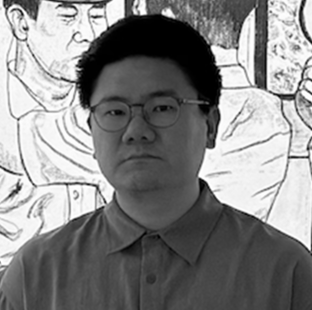
Ezekiel Wong
Web: wongkelwin.com
IG: @wongkelwin
Biography
Known for his sardonic wit, Ezekiel Wong’s practice draws on satire to surface tensions in society, geopolitics, and personal experience. His works adopt a comical yet critical lens to explore identity, systems of power, and contemporary life.
He has exhibited widely in Singapore and abroad. Selected exhibitions include Sama-Sama (Whitestone Gallery Singapore, 2025), curated by Dr. Wang Ruobing for SG60; Many Worlds at a Glance, Many Worlds All at Once (Institute of Contemporary Arts Singapore, 2024, part of LASALLE40); Signs and Wonders, Sighs and Wanders (SUPERMAMA Flagship @ 213, 2024); Commoners (Esplanade, 2017); Liminal State (Mizuma Gallery, 2016); and At Source (ION Art Gallery, 2015, Young Talent Programme Winners’ Solo Exhibition).
His works have also featured in the Singapore Night Festival (Opera in Motion: A Dynamic Tribute to Chinese Opera, 2024) and Light to Night Festival (Art in Motion: The Merlion Dance, 2021), and internationally at the AWAGAMI International Miniature Print Exhibition (Japan, 2023), Bienal do Douro (Portugal, 2018), Sabanci University (Turkey, 2010), and Pocket Films Festival (Japan, 2007).
Wong holds a Master’s Degree in Art Education from Nanyang Technological University, and a Bachelor’s Degree in Fine Arts (Honours) from LASALLE College of the Arts, Singapore-Goldsmiths, University of London.
Artworks
Wu Ji Lai, Qi Kua Mai
2025
Graphite on paper
210 × 297 cm
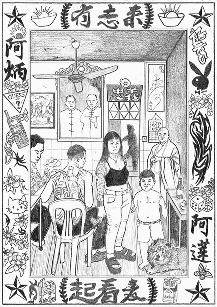
In this intricate graphite study, Wong appropriates the compositional structure of Diego Velázquez’s Baroque masterpiece, Las Meninas (1656), and transposes it into thegritty interior of a Singaporean shophouse.
Where Velázquez explored the power dynamics of the Spanish court through the act of looking, Wong reinterprets the “gaze” through the vernacular of the Ah Beng subculture. Here, the courtly gaze is replaced by the “staring game”—a ritual of territorial aggression often precipitating conflict on the streets. The central female figure anchors the composition, locking eyes with the viewer not in welcome, but in challenge.
The scene is enclosed by a “border of belongings,” a marginalia that catalogues the visual iconography of the era. The title, a Romanised Hokkien phrase meaning “If you have the guts, come and try,” completes the provocation.
By invoking the visceral slang for courage (Wu Ji, literally “having seed”), the work transforms the passive act of viewing into a confrontation, blurring the line between the spectator and the intruder.
SERIES STATEMENT
In a city that continually rewrites itself, the Ah Beng and Ah Lian linger as echoes of a particular time and attitude. Their gestures, movements, and styles formed a language of their own, shaped by aspiration, frustration, and the need to belong. The work does not seek to judge these figures, but instead looks beyond what is often dismissed as vulgar or excessive, turning toward the quieter structures of care, kinship, and survival that persist at the edges of aspiration.
In this series of works, Wong revisits these figures through drawing as a way of remembering what the city tends to forget. Each work traces the boundaries between rebellion and conformity, strength and insecurity, humour and weariness. The compositions emerge from research into films, magazines, fashion ephemera, photographs, everyday objects, and informal archives that once circulated through streets, bedrooms, and neighbourhoods.
Together, these fragments assemble an informal archive of gestures—pieces of a minor language that continues to speak from the margins, tender yet defiant, long after the world that shaped it has begun to fade.
369 Days With You
2026
Charcoal on linen
180 × 180 cm

In this intimate vignette, Wong transforms the HDB void deck, typically a space of public transit, into a site of fragile domesticity. An Ah Lian and Ah Beng rest upon a woven mat surrounded by the specific material culture of their time. The composition relies on a sharp juxtaposition.
In the foreground, the couple exists in a suspended state of intimacy and need. In the background, a passerby in office wear hurries home and averts his gaze. This figure embodies the accelerated rhythm of Singapore’s economic progress, a rhythm the central figures have stepped out of.
By capturing the Ah Lian’s confrontational yet restless stare, Wong monumentalises the vulnerability of “youths-at-risk.” The title, blurring a romantic anniversary with the numeric code of a secret society, suggests that within this subculture, the search for intimacy and belonging are inextricably linked.
24 Seven
2026
Charcoal on linen
180 × 180 cm
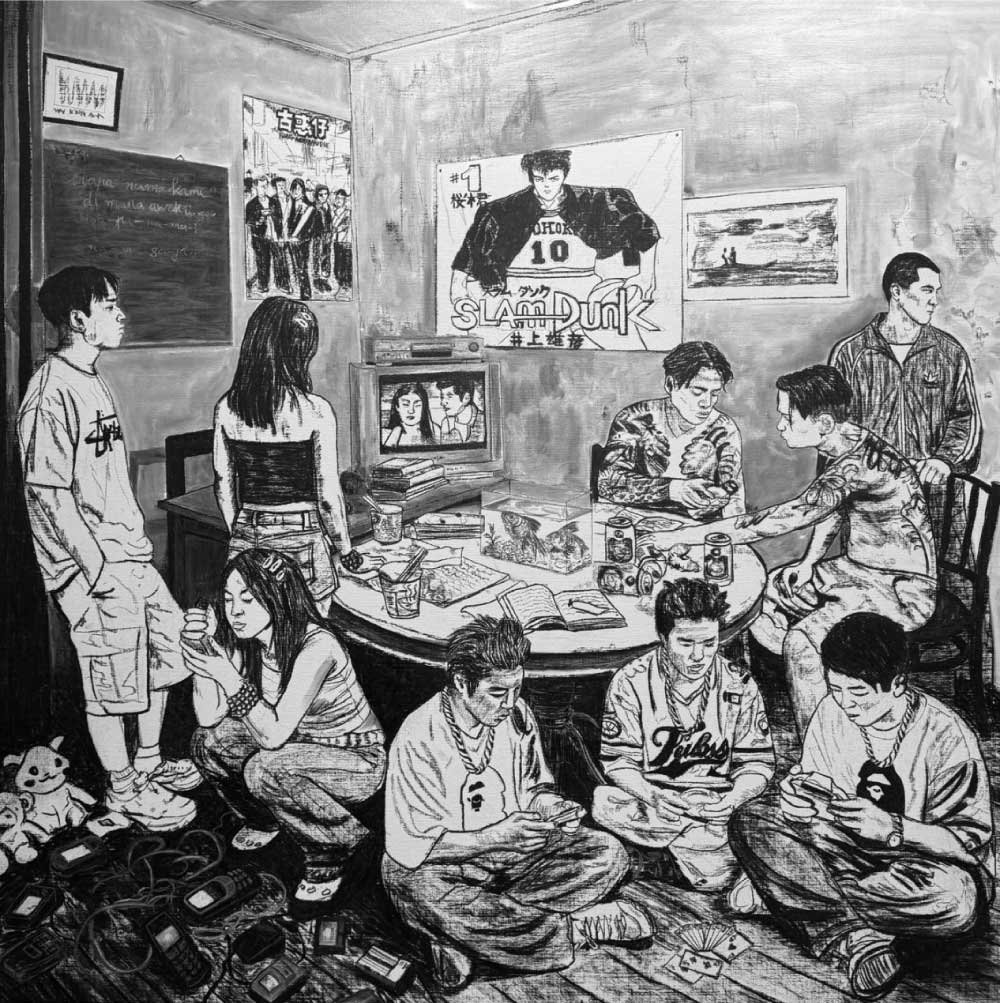
Reimagining Chua Mia Tee’s National Language Class (1959), Wong replaces the diligent optimism of nation-building with the sleepless drift of the “24/7” era.
The blackboard’s original questions—Siapa nama kamu? (What is your name?) and Di mana awak tinggal? (Where do you live?)—now resonate with irony. Here, the search for identity is drowned out by the noise of sanctuary: TV dramas, beer, and Nokia phones. Whether escaping fractured homes or the stifling expectations of a “perfect” family, these figures turn to the group for the protection and belonging missing from their daily lives.
The work captures the static left behind by Singapore’s speed, where the collective hunger of the past has dissolved into a fragmented struggle for survival.
108 Sheep and Counting
2026
Charcoal on linen
180 × 180 cm
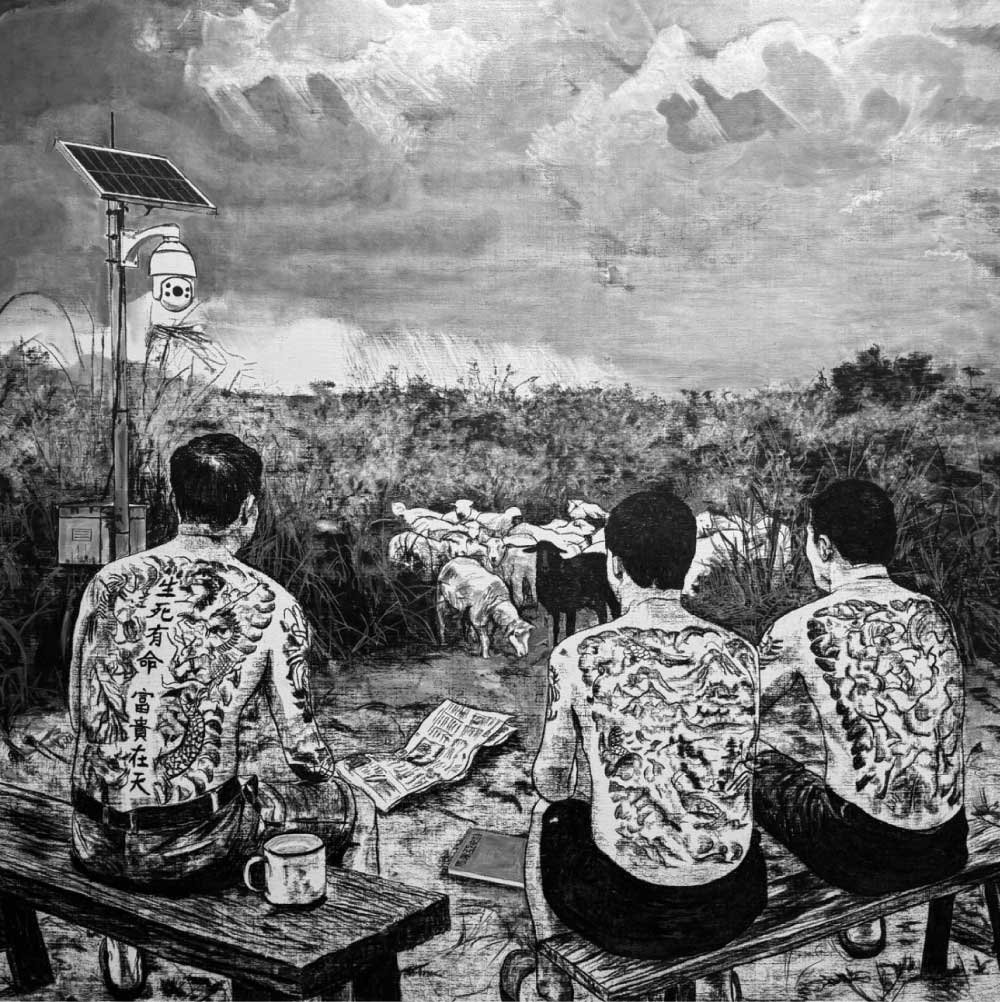
In this landscape, we encounter three older men, survivors of the street life, seated in the exact composition of Chua Mia Tee’s Epic Poem of Malaya (1955). Wong meticulously retains the artefacts of the original masterpiece, such as the mug and the fly resting on the man’s shoulder. Yet, the context has shifted from 1955 to 2026.
The impassioned orator of the past is gone. He is replaced by ageing veterans who sacrificed their youth to the oath of the brotherhood and are now left watching the world change. The inclusion of a CCTV camera anchors the scene in the present and transforms the romantic landscape into a surveillance zone.
The title, 108 Sheep and Counting, layers the numeric code of the Hai Lok San brotherhood with the metaphor of the herd. It suggests a cruel trajectory where the “lions” of the past have become the “black sheep” of the present, lingering in an epic scene that no longer has a poem to recite.