
Superlative Futures (Wong Zi Hao and Liu Dian Cong )

Web: superlativefutures.com
IG: @superlative_everything
Biography
Superlative Futures, a transdisciplinary design and research studio, gathers Stories of Ground from newspaper fragments, cartographic reinterpretations, and speculative seed architectures to imagine alternative ecologies that form new “memory palaces” to recall the substrate of ground beneath the rigid surfaces of the modern city. Stories of Ground highlights overlooked local histories that continue to grow in the interstices of urban life, proposing speculative worlds rooted in the material traces of place.
The Singapore-based studio was co-founded by Wong Zi Hao and Liu Dian Cong. Its research practice centers on creative modes of landscape representation to advocate new ways of seeing and, through that, to speculate on alternative futures where cities might better coexist with more-than-human worlds.
They see their design output as a practice of care.
They have exhibited at the NUS Museum and were supported by the Singapore Art Museum’s inaugural Design Research Fellowship (2024–2025). Wong received his PhD in Architecture from the National University of Singapore in 2023, completing a design-research thesis on intertidal practices of care. Alongside his research practice, Wong teaches at NUS’ Department of Architecture and at the Nanyang Academy of Fine Arts / University of the Arts Singapore (UAS). Liu currently practices as an architectural designer after completing his Master of Architecture at NUS in 2024, where he explored sedimentation and alternative conceptions of “ground.”
Artworks
Fireflies and Constellations
2026
Pencil and ink on pricked paper, with light box
980 x 580 mm
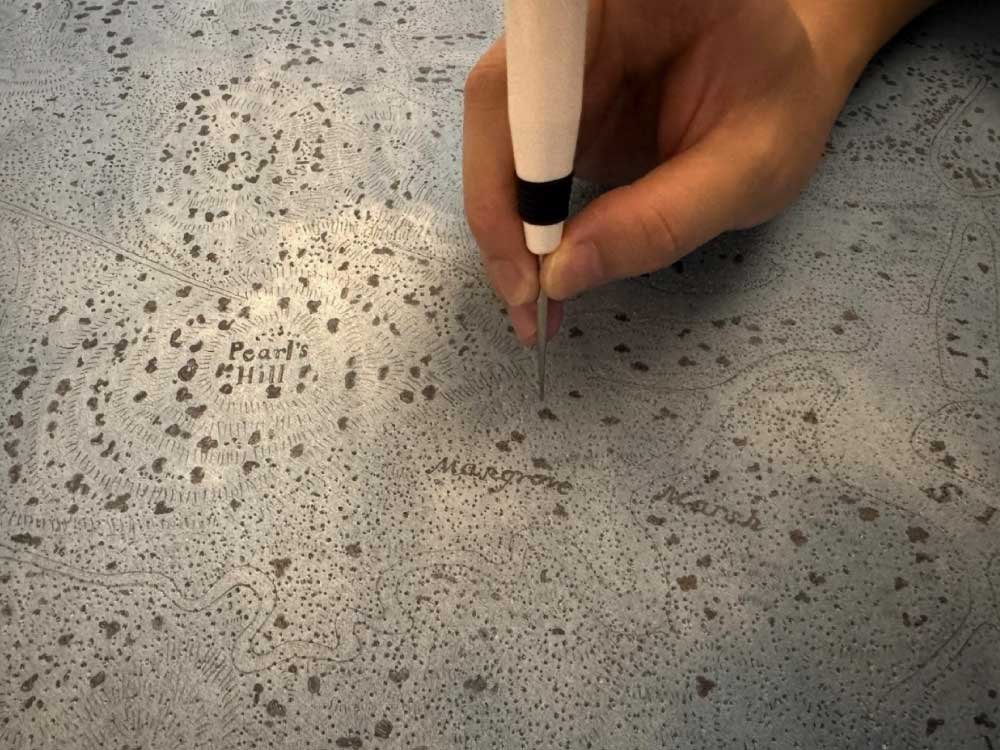
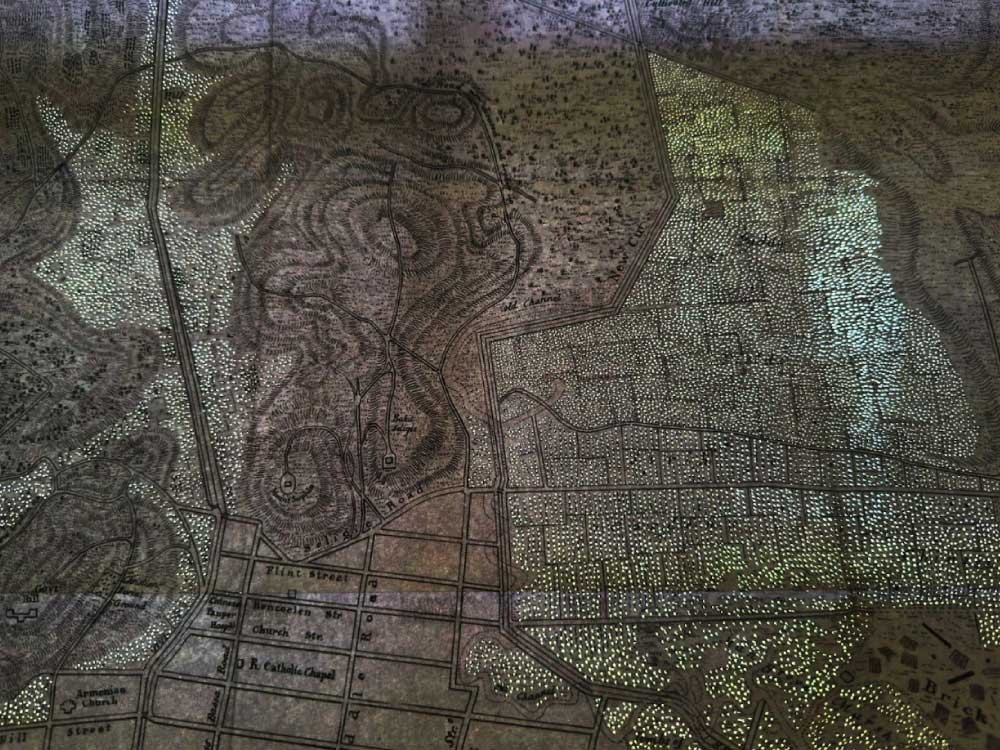
Before there was the map, the ground was not merely an undulating surface for scoring the architectural iron grid of urban planning. The 1836 Map of the Town and Environs of Singapore, drawn by French lithographer Jean-Baptiste (J. B.) Tassin and based on the survey of Singapore’s pioneering colonial architect and Superintendent of Public Works, George Drumgoole Coleman, represents one of the earliest instances of cartographical disciplining of the island-city’s landscape, and perhaps its ecological environs as well.
The artwork Fireflies constitutes a pair of backlit perforated drawings, or rather, re-drawings of the 1836 Map, to return a different imagination of the ground before there was the map. Contesting the map’s emphasis on comprehensive survey and engineering achievement, of gridded streets, cultivated hills, plantation grounds, and rechannelled rivers, the diptych instead zooms in to reveal other details and other grounds, obscured or erased by the map’s narrative of progress.
Through pricked surfaces and illuminated voids, the work reimagines the city centre’s dry, stable, and habitable ground as porous and unstable, saturated by monsoonal rains, flooded paddy fields, and mangrove marshes that once shifted with the tides of now-displaced rivers. The constellation-like points of light recall the fireflies of wet landscapes, often understood as messengers between worlds. In this reading, they mediate between living and ghostly realms, connecting the environmental crises of the present with submerged pasts and speculative futures.
Seed Palace
2025
Medium: Cardboard, Wood, String, Acrylic Paint
450 x 624 mm
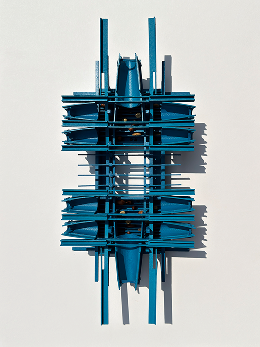
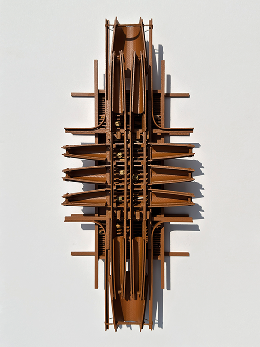
An architectural model, but also a speculative design artefact made to reimagine a world where humans build architectures for nonhuman subjects. The Seed Palaces call to mind seed vaults built all around the world functioning to physically preserve the genetic memory of seed matter in permafrost conditions, in anticipation of doomsday global ecological and food crisis. Here, the miniscule seed architectures extend these anticipatory practices to other forms of archival necessary for the present time, in cultivating new memory palaces around the substrate of ground, and other seed matter(s).
The artefacts act as memory “collages” of past and future grounds, connecting stories of ancient fruit orchards and forbidden hills, to colonial seed collections and experimental gardens, and to future heirloom seed vaults on the International Space Station.